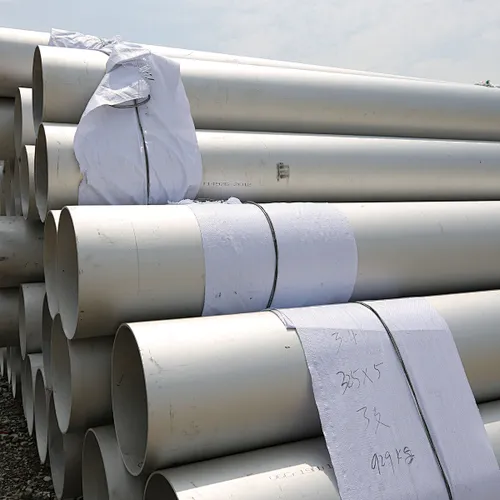
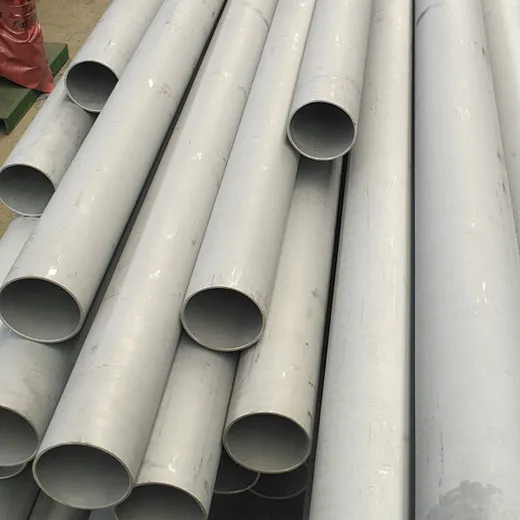
Seamless Stainless Steel TP310 Pipe
Featuring a strategic enrichment of 25% Chromium and 20% Nickel, our TP310 tubing develops a tenacious protective scale that ensures superior performance at continuous service temperatures up to 1100°C (2012°F). These pipes are indispensable for mission-critical applications in radiant tubes, muffle furnaces, and high-temperature chemical processing units. Through advanced cold-drawing and precise solution annealing, GZH guarantees a uniform microstructure and optimized creep strength, providing a reliable choice for the most demanding thermal cycling conditions.
“For applications requiring lower carbon content for welding, we also offer TP310S (UNS S31008), and for higher creep strength, TP310H (UNS S31009) is available.”
TP310 (UNS S31000 / 1.4841) Seamless Stainless Steel Pipe
Note on designation: TP310 is a legacy designation. The current ASTM A312 / A213 editions list 310S (UNS S31008) and 310H (UNS S31009); TP310 is supplied to the equivalent 25Cr-20Ni chemistry and mechanical requirements by agreement.
TP310 is the 25Cr-20Ni austenitic heat-resistant grade with high carbon, giving good strength and oxidation resistance at temperature. It is the base of the 310 family; 310S and 310H are the controlled-carbon variants used in most modern specifications.
GZH supplies TP310 seamless pipe in 6 – 1016 mm OD and SCH 5S – XXS (1 – 50 mm) wall, solution annealed, pickled or bright annealed, with EN 10204 3.1 certificates as standard and 3.2 on request.
Key specifications
| Grade | TP310 / UNS S31000 / EN 1.4841 / 20Cr25Ni20 (S31020) |
| Product standard | ASTM A312 (seamless); ASTM A213 for tube on request |
| Process | Seamless — hot extrusion / hot piercing, cold drawn or cold pilgered finishing |
| Outer diameter | 6 – 1016 mm |
| Wall thickness | SCH 5S – XXS (1 – 50 mm) |
| Length | Random, double random, cut to length up to 18 m |
| Ends | Plain, beveled |
| Delivery condition | Solution annealed, pickled or bright annealed |
| Certificate | EN 10204 3.1 (3.2 on request — ABS, DNV, LR, BV, TÜV) |
Chemical composition, % (per ASTM A312)
| C | Mn | Si | P | S | Cr | Ni |
|---|---|---|---|---|---|---|
| ≤ 0.25 | ≤ 2.00 | ≤ 1.50 | ≤ 0.045 | ≤ 0.030 | 24.0 – 26.0 | 19.0 – 22.0 |
Mechanical and physical properties
| Tensile strength, room temperature | ≥ 515 MPa | ASTM A312 minimum |
| Yield strength (0.2% offset) | ≥ 205 MPa | ASTM A312 minimum |
| Elongation in 2 in. or 50 mm | ≥ 35% | ASTM A312 minimum |
| Hardness | ≤ 95 HRB (typical) | Published typical value |
| Density | 7.9 g/cm³ | Published typical value |
| Melting range | ≈ 1400 – 1450 °C | Published typical value |
| Thermal expansion, 20 – 100 °C | ≈ 16.0 µm/m·K | Published typical value |
| Heat treatment | 1040 – 1120 °C, water quenched | Standard practice |
TP310 compared with related grades
| Grade | Key alloying | Typical use | Watch out for |
|---|---|---|---|
| TP304 | 18Cr-8Ni | General corrosion, food, water | Chloride SCC above 60 °C |
| TP316L | 16Cr-10Ni-2Mo | Chloride and chemical service | SCC in hot concentrated chlorides |
| TP321 | 18Cr-10Ni-Ti stabilised | Welded high-temperature piping | Lower creep strength than 321H |
When to choose TP310, and when not to
- You are replacing an existing 310 specification and the original standard calls for TP310.
- Oxidation resistance at 1000–1050 °C is the design driver.
- Cost of 310S is not justified by weldability needs.
- New welded designs: specify 310S for lower carbon and better weldability.
- Creep-critical service above 600 °C: use 310H.
- Sulfur-bearing or reducing atmospheres.
Typical applications
Mill, stock and incoming inspection
- Every heat comes from our parent mill and arrives with an EN 10204 3.1 certificate stating heat number, chemistry and mechanical results.
- Mill route, for reference: hot extrusion or hot piercing, then cold drawing or cold pilgering at GZH. Stock we hold is finished to these routes.
- Solution annealed at 1040–1120 °C and water quenched at the mill; pickled or bright annealed to your specification.
- Mill tests to the standard, plus our own incoming check: PMI/XRF grade verification, dimensions, ovality and surface. Third-party inspection by SGS, BV, TÜV or your nominated agency on request.
Certificates
Every shipment includes an EN 10204 3.1 mill test certificate with heat number, chemistry, mechanical results and test reports. EN 10204 3.2 is available through your nominated inspection agency.
Packing and delivery
Pipes are end-capped, bundled and packed in plywood cases or steel frames for sea freight. Loading port: Shanghai / Ningbo or as requested. Contact us for current lead time and stock sizes.
How to request a quote
Send us: outer diameter, wall thickness or schedule, length, quantity, standard and certificate level, delivery condition, destination port. We reply within 24 hours.
Contact:supply@xtd-ss.com · +86-577-88989817