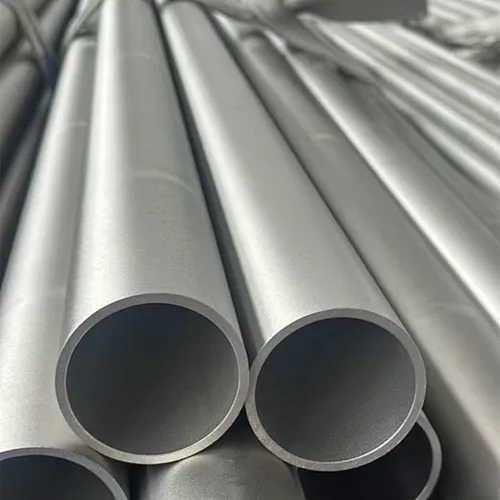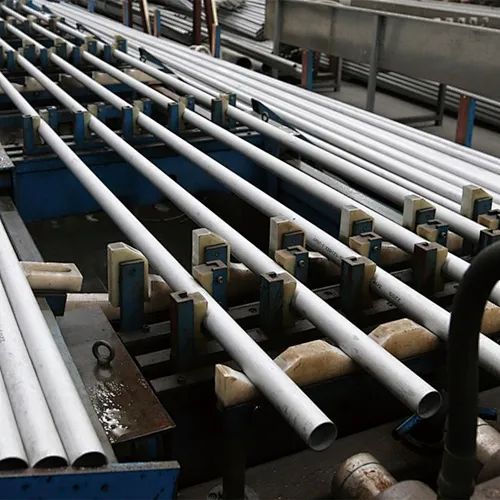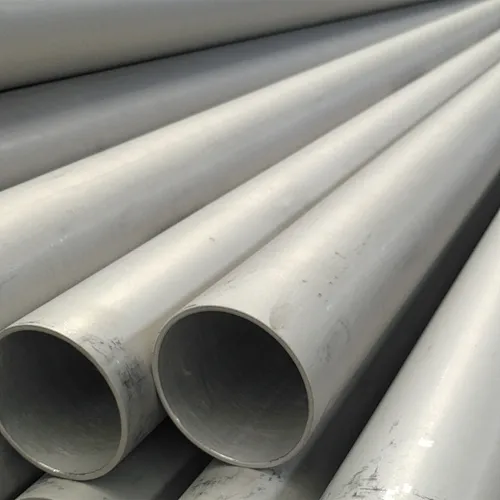
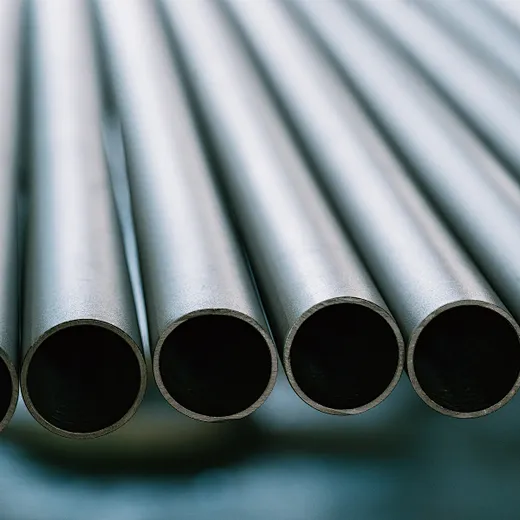
Seamless Hastelloy B2 pipe
Our Hastelloy B2 seamless pipes are designed to resist the formation of grain-boundary carbide precipitates in the weld heat-affected zone, ensuring superior intergranular corrosion resistance in the as-welded condition. This alloy offers outstanding protection against pitting, stress-corrosion cracking (SCC), and sulfuric or phosphoric acids in reducing environments. Finished by cold drawing and vacuum annealing at our parent mill, GZH verifies every pipe maintains tight dimensional tolerances and a high-integrity surface finish for the most demanding chemical processing and petrochemical applications.
“For applications requiring enhanced thermal stability during fabrication, please also check our Hastelloy B3 solutions.”
Hastelloy B2 (UNS N10665 / 2.4617) Seamless Nickel Alloy Pipe
Hastelloy B2 (UNS N10665) is a nickel-molybdenum alloy with 28% molybdenum, designed for hydrochloric acid and other reducing acids. It has excellent resistance to chloride stress corrosion cracking and to pure sulfuric acid.
GZH supplies Hastelloy B2 seamless pipe in 6 – 762 mm OD and SCH 5S – XXS (0.5 – 40 mm) wall, solution annealed and pickled, with EN 10204 3.1 certificates as standard and 3.2 on request.
Key specifications
| Grade | Hastelloy B2 / UNS N10665 / EN 2.4617 / NS3202 |
| Product standard | ASTM B622 (seamless); ASTM B626 for tube on request |
| Process | Seamless — hot extrusion / hot piercing, cold drawn or cold pilgered finishing |
| Outer diameter | 6 – 762 mm |
| Wall thickness | SCH 5S – XXS (0.5 – 40 mm) |
| Length | Random, double random, cut to length up to 18 m |
| Ends | Plain, beveled |
| Delivery condition | Solution annealed and pickled |
| Certificate | EN 10204 3.1 (3.2 on request — ABS, DNV, LR, BV, TÜV) |
Chemical composition, % (per ASTM B622)
| Ni | Mo | Fe | Cr | C | Mn | Si |
|---|---|---|---|---|---|---|
| balance | 26.0 – 30.0 | ≤ 2.00 | ≤ 1.00 | ≤ 0.02 | ≤ 1.00 | ≤ 0.10 |
Mechanical and physical properties
| Tensile strength, room temperature | ≥ 760 MPa | ASTM B622 minimum |
| Yield strength (0.2% offset) | ≥ 350 MPa | ASTM B622 minimum |
| Elongation in 2 in. or 50 mm | ≥ 40% | ASTM B622 minimum |
| Hardness | ≤ 100 HRB (typical) | Published typical value |
| Density | 8.4 g/cm³ | Published typical value |
| Melting range | ≈ 1350 – 1400 °C | Published typical value |
| Thermal expansion, 20 – 100 °C | ≈ 13.0 µm/m·K | Published typical value |
| Heat treatment | 980 – 1080 °C, water quenched | Standard practice |
Hastelloy B2 compared with related grades
| Grade | Key alloying | Typical use | Watch out for |
|---|---|---|---|
| Inconel 600 | 72Ni-15Cr | High-temperature oxidation, caustic | Sulfidation in sulfur gases |
| Inconel 625 | 58Ni-21Cr-9Mo-Nb | Corrosion plus high temperature | Higher cost |
| Incoloy 825 | 42Ni-21Cr-3Mo-Cu | Sulfuric and phosphoric acid | Not for hydrochloric acid |
When to choose Hastelloy B2, and when not to
- The medium is a reducing acid with no oxidizing species or dissolved oxygen.
- Chloride SCC resistance is required.
- Hydrochloric acid concentration and temperature exceed C276 limits.
- Any oxidizing medium: B2 corrodes rapidly.
- Aerated or oxygen-contaminated streams.
- Service above 400 °C.
Typical applications
Mill, stock and incoming inspection
- Every heat comes from our parent mill and arrives with an EN 10204 3.1 certificate stating heat number, chemistry and mechanical results.
- Mill route, for reference: hot extrusion or hot piercing, then cold drawing or cold pilgering at GZH. Stock we hold is finished to these routes.
- Solution annealed at 1040–1120 °C and water quenched at the mill; pickled or bright annealed to your specification.
- Mill tests to the standard, plus our own incoming check: PMI/XRF grade verification, dimensions, ovality and surface. Third-party inspection by SGS, BV, TÜV or your nominated agency on request.
Certificates
Every shipment includes an EN 10204 3.1 mill test certificate with heat number, chemistry, mechanical results and test reports. EN 10204 3.2 is available through your nominated inspection agency.
Packing and delivery
Pipes are end-capped, bundled and packed in plywood cases or steel frames for sea freight. Loading port: Shanghai / Ningbo or as requested. Contact us for current lead time and stock sizes.
How to request a quote
Send us: outer diameter, wall thickness or schedule, length, quantity, standard and certificate level, delivery condition, destination port. We reply within 24 hours.
Contact:supply@xtd-ss.com · +86-577-88989817