
Seamless Hastelloy C22 tube
Distinguished by its optimized chemistry, Hastelloy C22 provides superior resistance to pitting, crevice corrosion, and stress corrosion cracking (SCC), outperforming Alloy C276 in oxidizing environments containing wet chlorine and nitric acid. These tubes are indispensable for mission-critical applications in chemical reactors, pharmaceutical synthesizers, and flue gas desulfurization (FGD) systems. Finished by cold drawing and precise vacuum annealing at our parent mill, GZH verifies every tube maintains a uniform microstructure and maximum structural reliability under aggressive industrial conditions.
C22 PREN ≈ 45+
Hastelloy C22 (UNS N06022 / 2.4602) Seamless Nickel Alloy Tube
Hastelloy C22 (UNS N06022) is a nickel-chromium-molybdenum-tungsten alloy with higher chromium than C276 (22% versus 16%). The extra chromium improves resistance to oxidizing media such as nitric acid, ferric chloride and wet chlorine while keeping C276-level reducing acid resistance.
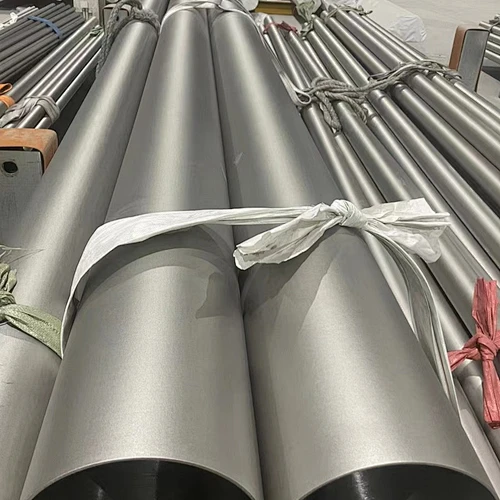
GZH supplies Hastelloy C22 seamless tube in 6 – 762 mm OD and SCH 5S – XXS (0.5 – 40 mm) wall, solution annealed and pickled, with EN 10204 3.1 certificates as standard and 3.2 on request.
Key specifications
| Grade | Hastelloy C22 / UNS N06022 / EN 2.4602 / NS3302 |
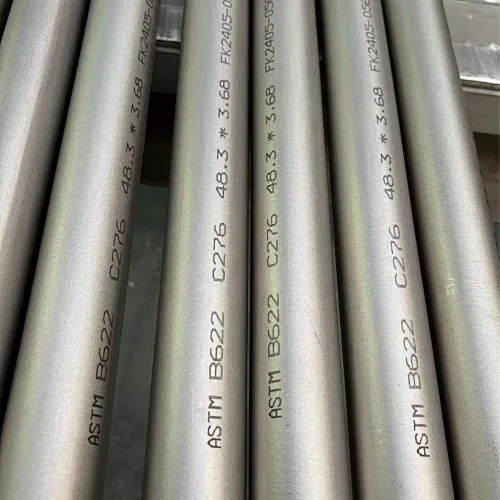
| Product standard | ASTM B626 (seamless); ASTM B622 for pipe on request |
| Process | Seamless — hot extrusion / hot piercing, cold drawn or cold pilgered finishing |
| Outer diameter | 6 – 762 mm |
| Wall thickness | SCH 5S – XXS (0.5 – 40 mm) |
| Length | Random, double random, cut to length up to 18 m |
| Ends | Plain, beveled |
| Delivery condition | Solution annealed and pickled |
| Certificate | EN 10204 3.1 (3.2 on request — ABS, DNV, LR, BV, TÜV) |
Chemical composition, % (per ASTM B622)
| Ni | Cr | Mo | W | Fe | Co | C | Mn | Si |
|---|---|---|---|---|---|---|---|---|
| balance | 20.0 – 22.5 | 12.5 – 14.5 | 2.50 – 3.50 | 2.00 – 6.00 | ≤ 2.50 | ≤ 0.015 | ≤ 0.50 | ≤ 0.08 |
Mechanical and physical properties
| Tensile strength, room temperature | ≥ 690 MPa | ASTM B622 minimum |
| Yield strength (0.2% offset) | ≥ 310 MPa | ASTM B622 minimum |
| Elongation in 2 in. or 50 mm | ≥ 45% | ASTM B622 minimum |
| Hardness | ≤ 100 HRB (typical) | Published typical value |
| Density | 8.4 g/cm³ | Published typical value |
| Melting range | ≈ 1350 – 1400 °C | Published typical value |
| Thermal expansion, 20 – 100 °C | ≈ 13.0 µm/m·K | Published typical value |
| Heat treatment | 980 – 1080 °C, water quenched | Standard practice |
Hastelloy C22 compared with related grades
| Grade | Key alloying | Typical use | Watch out for |
|---|---|---|---|
| Inconel 600 | 72Ni-15Cr | High-temperature oxidation, caustic | Sulfidation in sulfur gases |
| Inconel 625 | 58Ni-21Cr-9Mo-Nb | Corrosion plus high temperature | Higher cost |
| Incoloy 825 | 42Ni-21Cr-3Mo-Cu | Sulfuric and phosphoric acid | Not for hydrochloric acid |
When to choose Hastelloy C22, and when not to
- Both oxidizing and reducing media appear in the process.
- C276 shows corrosion in an oxidizing stream.
- You need one alloy across several process steps.
- Hydrochloric acid at high concentration and temperature: C276 or B3.
- Cost-sensitive projects where Alloy 31 works.
- Service above 675 °C under pressure.
Typical applications
Mill, stock and incoming inspection
- Every heat comes from our parent mill and arrives with an EN 10204 3.1 certificate stating heat number, chemistry and mechanical results.
- Mill route, for reference: hot extrusion or hot piercing, then cold drawing or cold pilgering at GZH. Stock we hold is finished to these routes.
- Solution annealed at 1040–1120 °C and water quenched at the mill; pickled or bright annealed to your specification.
- Mill tests to the standard, plus our own incoming check: PMI/XRF grade verification, dimensions, ovality and surface. Third-party inspection by SGS, BV, TÜV or your nominated agency on request.
Certificates
Every shipment includes an EN 10204 3.1 mill test certificate with heat number, chemistry, mechanical results and test reports. EN 10204 3.2 is available through your nominated inspection agency.
Packing and delivery
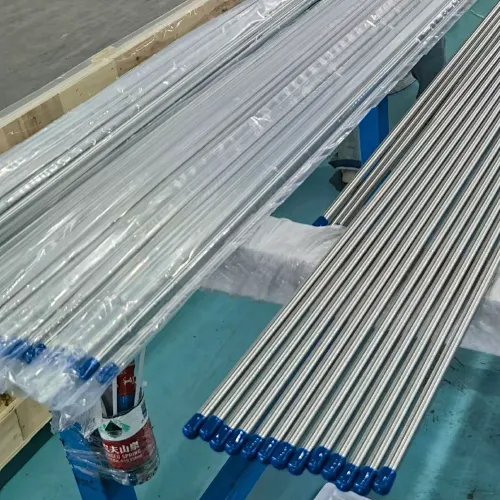
Tubes are end-capped, bundled and packed in plywood cases or steel frames for sea freight. Loading port: Shanghai / Ningbo or as requested. Contact us for current lead time and stock sizes.
How to request a quote
Send us: outer diameter, wall thickness or schedule, length, quantity, standard and certificate level, delivery condition, destination port. We reply within 24 hours.
Contact:supply@xtd-ss.com · +86-577-88989817